

Nas' Open Letter to the Music Industry: Is Nas Right?
Nas dropped a letter. My brothers and I sat down in a real studio to figure out what he meant, and whether he's right.
Nas wrote a letter.
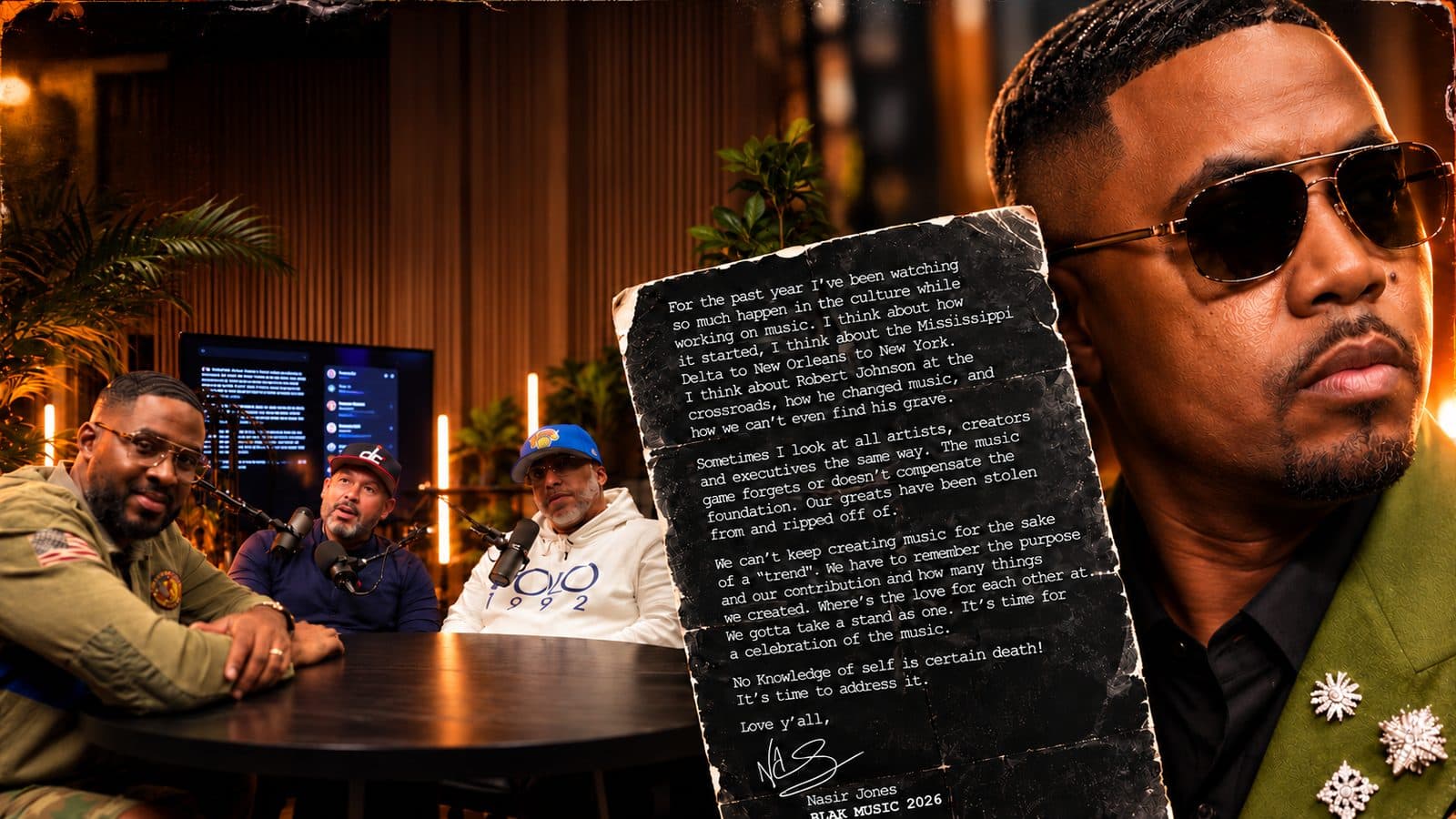
On October 15, he posted it to Instagram. No album announcement. No tracklist. Just a few short paragraphs about Robert Johnson, the foundation of this music, and a culture that keeps chasing trends.
He signed it "Love y'all, Nas." Then one line underneath: BLAK MUSIC 2026.
That was enough. For the first time, I took the conversation out of the garage and into a real studio. I sat down with my brothers El Capo, Maintain and Aris, and we went through that letter line by line. Here's where we landed.
"For the Past Year"... Or for the Past 30?
The letter opens with Nas saying that for the past year he's been watching so much happen in the culture while working on music.
The past year? That was the first thing that caught us. Because Nas has ALWAYS been like this. This is the man who said Hip-Hop is dead. The man who got on the radio and told his own peers to step their lyrics up. He's been watching the trends come and go since Illmatic.
Maintain put it plainly: "He's always been like this. Nas has always been telling us for 30 years."
So what's different now?
We all landed in the same place. This isn't a complaint. It's a pulse check. Like I said at the table, every now and again Nas does a Hip-Hop pulse check, and this letter is the latest reading.
Aris had a theory of his own, half joking: "I think he fluffed this up. He used ChatGPT to write this."
He said it with a smile, but the point was a compliment. Nas is sharp. He's online, he's watching the same fatigue everybody else is, and he made sure every word landed.
And Aris caught something in that wording. Nas doesn't just say artists. He says artists, creators AND executives. That's deliberate. The people putting the music out carry as much weight as the people making it.
Why Robert Johnson?
Nas starts the whole letter at the crossroads. The Mississippi Delta to New Orleans to New York. Robert Johnson, the bluesman who changed music, and whose grave we can't even find.
The folklore is the folklore. Johnson couldn't play. He disappeared, came back, and suddenly he could play his ass off. Word was he made a deal with the devil at the crossroads.
So why open with him?
One read: he's the earliest example Nas could reach for. The root of the tree. Before Hip-Hop, before jazz, there was the Delta.
The other read hits harder. Robert Johnson is the original story of selling your soul for the gift. And look around today... how many artists across every genre are trading themselves to pop culture for a moment in the light?
Nas doesn't say which one he means. That's the beauty of it. He leaves it to us.
"The Music Game Forgets the Foundation"
This is the line that hit me the hardest. The music game forgets or doesn't compensate the foundation. Our greats have been stolen from and ripped off of.
I recently saw Grand Puba on stage, and something didn't sit right with me. No disrespect at all. I love Grand Puba. This is the man who put Tommy Hilfiger on his back. If you know, you know.
But seeing him up there, I had to ask... what is going on with our OGs? The industry treats them the way the government treats our veterans. They gave everything, and when it's over, nobody's taking care of them.
Paid in Full
Here's the thing. Somebody IS trying to do something about it.
The Paid in Full Foundation was started by Ben and Felicia Horowitz, and Nas sits on its advisory board. Rakim and Scarface were the first honorees in 2023. Grandmaster Caz, Roxanne Shante and Kool Moe Dee followed in 2024. The latest Hip Hop Grandmaster Awards just went down in Las Vegas on October 24, with Kurtis Blow and The D.O.C. among the honorees.
And there's one rule from Nas that says everything about how they approach it: you can't just hand these legends a check. It has to come with respect. So the money comes attached to an award and a public celebration. The honor is what makes the money land with dignity.
From the coverage we read on the pod, the grant is paid out over five years, not as a lump sum, and Caz used his to buy a house and finally move out of the projects. Caz said it best: Hip-Hop doesn't have social security. You just have to keep working.
If we're not taking care of the generation that built this, how can we expect the next generation to take care of us?
Who Owns the Music?
You can't talk about compensation without talking about masters.
Look at Salt-N-Pepa. In the '80s, they signed with Hurby Luv Bug's production company, which passed the rights on to Next Plateau Records. UMG ended up holding the catalog.
After 35 years, artists are supposed to be able to reclaim their work. But in January 2026, a federal judge dismissed their case, ruling that Salt-N-Pepa never owned the recordings in the first place, so there was nothing to take back. They've appealed.
Think about that. One of the biggest groups in Hip-Hop history, and the paperwork says they never owned their own music. De La Soul fought a version of this fight. So did Tribe.
That's what Nas means by stolen from and ripped off of. It's not a metaphor. It's a contract.
Remember the Purpose
Nas writes that we can't keep creating music for the sake of a trend. We have to remember the purpose in our contribution.
So we asked the question straight up: if somebody's purpose for making Hip-Hop is simply to get rich, is that less valid?
The table said yes. Not because money is the problem. We all want to get paid. Big Pun told us that a long time ago. The operative word is SIMPLY. If money is the only reason, your heart isn't all the way in it.
The artists we grew up on did it for the love, and the money came as a result. Not the other way around.
Learn Your History
But Maintain wasn't letting the young generation slide.
He listens to jazz today because of A Tribe Called Quest. Those samples sent him looking for the source. He read the Miles Davis autobiography, then learned Coltrane, Nina Simone and Billie Holiday. In his words: "I'm a Hip-Hop head, but I can confidently speak on jazz like the back of my hand, because I'm a student."
El Capo's route was different. For him, it was Pete Rock & CL Smooth, that jazz-heavy early '90s sound from right before Illmatic and 36 Chambers came out.
For me, it goes back even further. Growing up Dominican, Saturday morning meant cleaning the house to Aramis Camilo and Juan Luis Guerra. Real musicians. Full bands. That's where my ear came from.
So to the young heads: knowing your history isn't corny. It's a flex. If you're in your 20s and you can talk early Nas, Slick Rick, Big Daddy Kane and Rakim, that's power.
And to my generation: meet them where they're at. Come with curiosity, not a lecture. We're the generation that bridges the old heads and the new ones. That's our job now.
So... Is Nas Right?
El Capo said it first: "Nas is right. And once again, this has been going on for too long."
I agree. Honestly, he's been right for a long time.
The letter is vague in places. We had to sit for over an hour to unpack a few paragraphs. But it covers everything that matters: history, compensation, chasing trends, and ownership.
If this brings better music, and more ownership back to the people who built the culture, that's the greater good. And I don't think anybody else could have delivered that message the way Nas did.
The one question still in the air... what is BLAK MUSIC 2026? Album? Movement? Label? We'll find out.
Now I want to hear from you. Is Nas right about where music is at in 2026? And which legend deserves their flowers next? Let me know in the comments on the full episode.
These Are the Hip-Hop Conversations We Should Be Having.
Sources
- Nas Urges Music Industry to Honor and Pay the Black Artists Who Shaped Generations (theGrio)
- Nas on Trend-Chasing, Unity and the Paid in Full Hip Hop Grandmaster Awards (Sneakz & Beatz)
- Hip-Hop Pioneers Honored at Las Vegas Strip Event (Las Vegas Review-Journal)
- Nas, Grandmaster Caz, Steve Stoute & Ben Horowitz on Paying Hip-Hop's Pioneers Their Due (a16z)
- Salt-N-Pepa Appeal UMG Masters Ruling (Digital Music News)
Written by Broadway the Lyricist
Tap In
Stay Up On the Latest Conversations.
New videos, blog stories, and The Bar Lounge drops, straight from Broadway to your inbox. No spam.